The trusted way to design, build & buy a home in Oman.
eBinaa connects Omani homeowners with verified architects, contractors and developers across three journeys — Design, Build and Buy. Bilingual (English / Arabic RTL), free for homeowners, integrated with Oman Housing Bank, and built on standardized contracts and stage-based payments. I led the end-to-end product experience.

Role
Lead Product Designer
Platform
Responsive web + Arabic RTL
Partner
Oman Housing Bank
Year
2026
A whole home journey — design, build & buy.
eBinaa connects homeowners in Oman with verified architects, contractors and developers — from designing a home, to building it under a structured contract with stage-based payments, to buying a ready or off-plan property. It's free for owners, bilingual (English / Arabic), and covers all nine governorates.
The product had one organizing idea: remove risk from the biggest purchase of someone's life. Trust here isn't a marketing word — it's built into verified company profiles, standardized contracts, a 5% retention policy, and payments that only release as real work is completed.
Building a home meant trusting strangers with your life savings.
One. No way to verify reputation. Contractors and architects were judged on word of mouth — there was no reliable record of who actually delivered quality work.
Two. Informal deals, no protection. Agreements were verbal and money was often paid upfront, so if a contractor abandoned the job mid-way, the owner had little recourse and real losses.
Three. A scattered, invisible process. Design, contracting, permitting and buying lived in disconnected places — with no progress visibility, no easy way to compare firms, and limited access to housing finance.
Before designing, I mapped who we were really designing for.
The platform serves homeowners, companies and partners — but the homeowner is the centre of gravity. I built the design around one primary persona: an Omani planning to build a home on their granted land, and the firms and institutions they have to learn to trust.
A note on rigor: the primary persona is synthesized from eBinaa's product context and Oman's land-grant building culture rather than a formal interview study, then pressure-tested against the firms and partners an owner relies on. It gave every later decision a person to design for.
Goals
- Build a quality home within budget
- Know exactly who to trust
- See progress without chasing anyone
Pain points
- Can't verify a firm's track record
- Fears overpaying and abandonment
- Process scattered across people & paper
“This is my life's biggest investment — I need to know the people I'm trusting are real.”
What they need
- Companies: reach serious, ready owners
- Oman Housing Bank: connect buyers to finance
- MoCIIP: regulatory credibility & oversight
Friction
- Hard to reach owners ready to commit
- No standard, enforceable contract
- The trust gap cuts both ways
“Owners won't commit until they believe the firm — and the contract — are real.”
Trust is the #1 barrier.
Led to → verification-first company profiles: ratings, completed projects, engineers and minimum price, shown up front.
Money feels unsafe.
Led to → standardized contracts, a 5% retention policy, and payments released stage by stage.
The journey is scattered.
Led to → one platform across Design, Build and Buy, with a built-in project management tool.
It all collapsed into one question.
The research pointed one way: eBinaa wouldn't win or lose on features — it would win or lose on trust. A homeowner had to believe the company was real, the contract was fair, and the money was safe before they'd commit to anything.
— The questionHow might we give homeowners in Oman one trusted place to design, build and buy a home — where every company is verified, every contract is fair, and every payment follows real, completed work?
Trust, made structural.
Verification, contracts, retention and staged payments are designed into the product — not promised in copy.
Design lifecycles, not screens.
Every project is an honest state machine — submit, contract, build, pay, hand over — with no dead ends and no guessing.
Bilingual by mirror.
Arabic RTL is designed as a complete right-to-left mirror, not a translation bolted on at the end.
What I owned, end to end.
Architecture
The navigation model — Design, Build, Buy — and how firms, projects, contracts and listings relate.
Interaction
The build journey, firm comparison, the contract and stage-based payments, and property search.
UI system
A trust-first component library: company cards, comparison tables, contract steps, filters, navigation.
RTL
The Arabic right-to-left experience designed as a first-class mirror, not an afterthought.
Design QA
Consistency held across dozens of screens, in both directions.
Exploration
Layout directions for the highest-traffic screens — the firm marketplace and property search — before converging.
What success looks like, on both sides.
Every design decision answered to two scoreboards at once — the platform's need to grow a verified, transacting marketplace (it monetizes from the business side), and the homeowner's need to design, build or buy with total confidence.
Grow the verified marketplace.
Make verified firms and fair, contracted projects the norm — and the reason companies pay to be on the platform.
Design, build or buy — with confidence.
Give an Omani homeowner everything they need to make the biggest decision of their life, in one trusted place.
Trust, made structural.
eBinaa's whole reason to exist is trust. Rather than asking homeowners to take a leap of faith, the design builds trust into the mechanics — who you work with, the contract you sign, and how the money moves.
Three journeys, one home.
The product is organized around three top-level services — Design, Build and Buy — plus the homeowner's account and a project management tool. The IA mirrors the real journey: design your home, build it under contract, or buy one ready-made — with trust signals one tap away.
- Architect firms
- Compare profiles
- 3D / landscape / MEP
- Connect
- Submit project
- Structure / Turn-key
- Matched firms
- Contract & pay
- Property marketplace
- Villas / townhouses
- Price & bedroom filters
- OHB finance
- Milestones
- Stage approvals
- Progress & updates
- Profile
- Saved firms
- Documents
- ع / EN
Top-level navigation — Design, Build and Buy down one rail, with account and progress one tap away.
- Plot location
- Drawing status
- Build type
- Verified contractors
- Supervision consultant
- Compare offers
- Standardized terms
- 5% retention
- Sign
- Stage-based release
- PM tool
- Progress
- Open projects
- Language ع / EN
- Notifications
- Account
The build journey — submit, match, contract, then build with money released stage by stage.
Every screen speaks two languages.
Arabic isn't a translation bolted on — it's a complete right-to-left mirror: navigation on the right, mirrored cards, and a fully localized vocabulary. Designing both directions kept the layout, component and spacing systems honest.
Four things you do here.
Design a home, build it under contract, buy one ready-made, and track it all the way — each module is a surface in the platform, and each one is held to the same standard of trust.
From empty plot to handover. Eight honest stages.
I modeled the homeowner's build journey as a state machine rather than a set of screens — every stage has one clear status, and money only moves when real work is verified.
One empty plot. eBinaa carried it all the way to the keys.
Structure in grayscale, first.
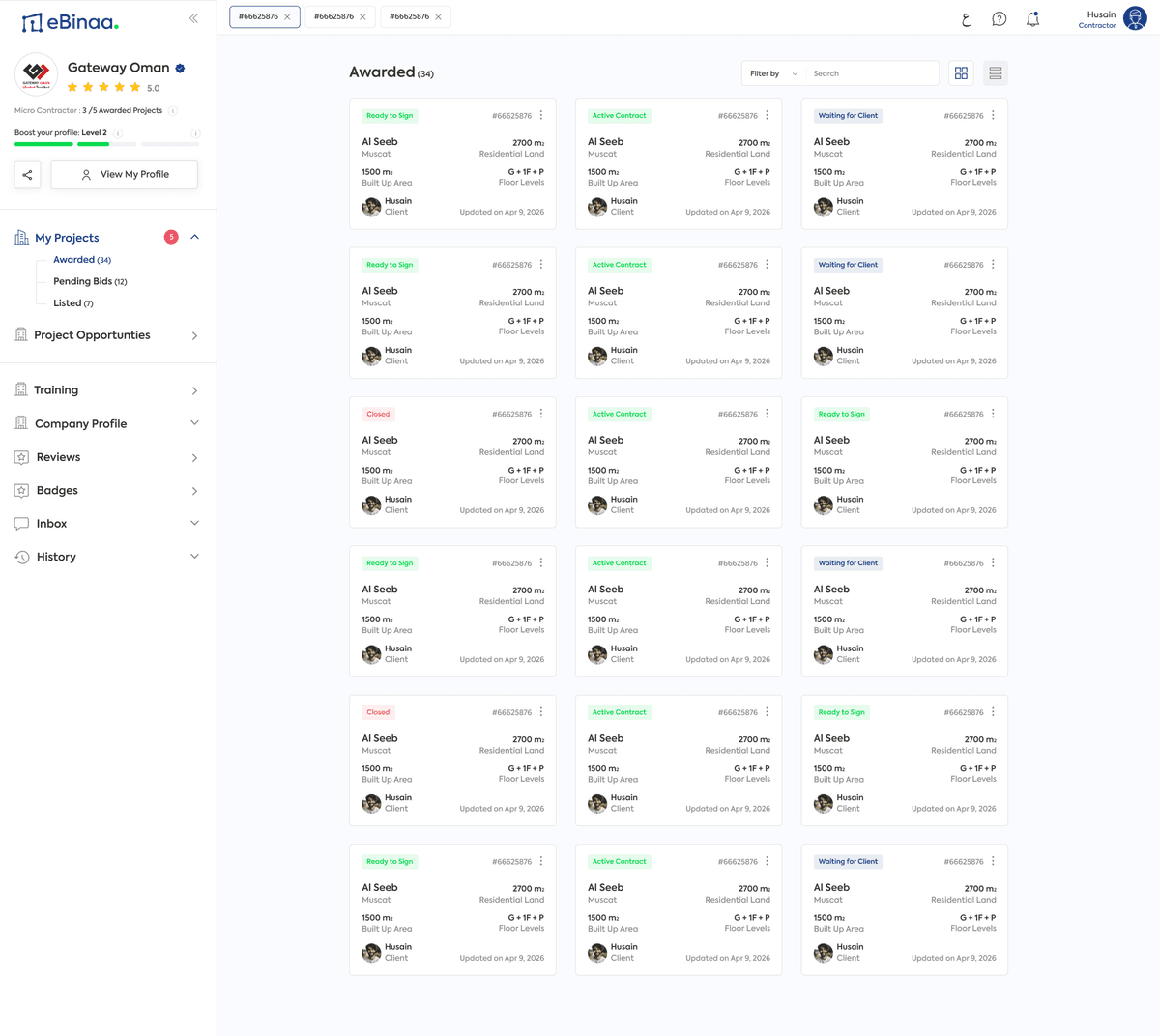
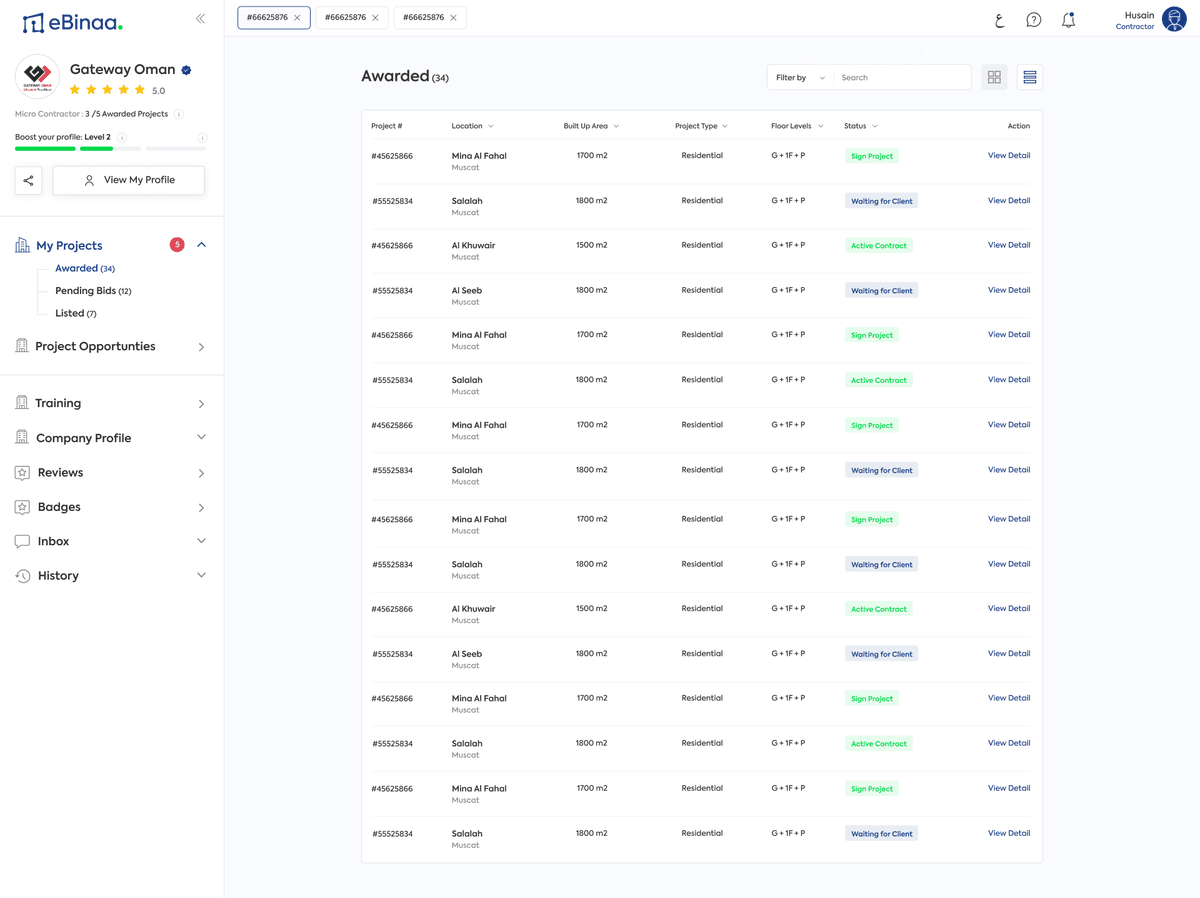
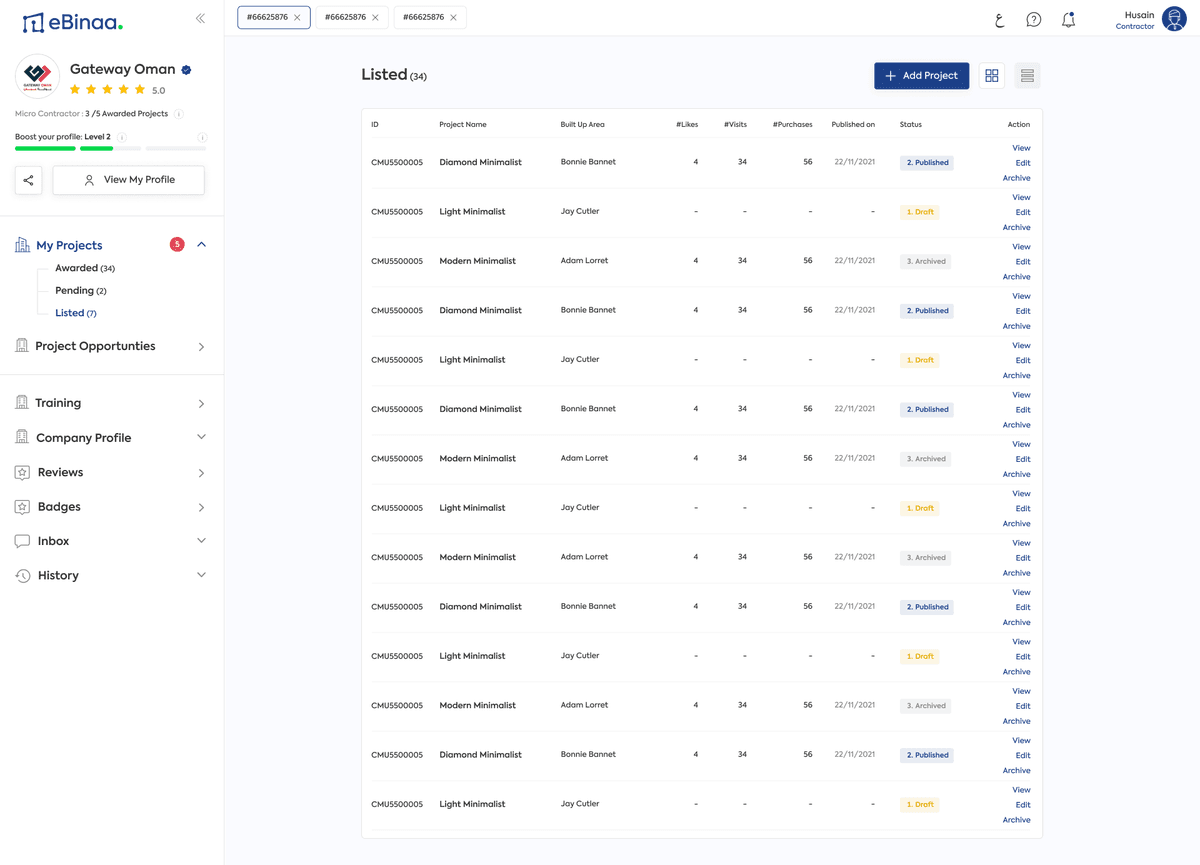
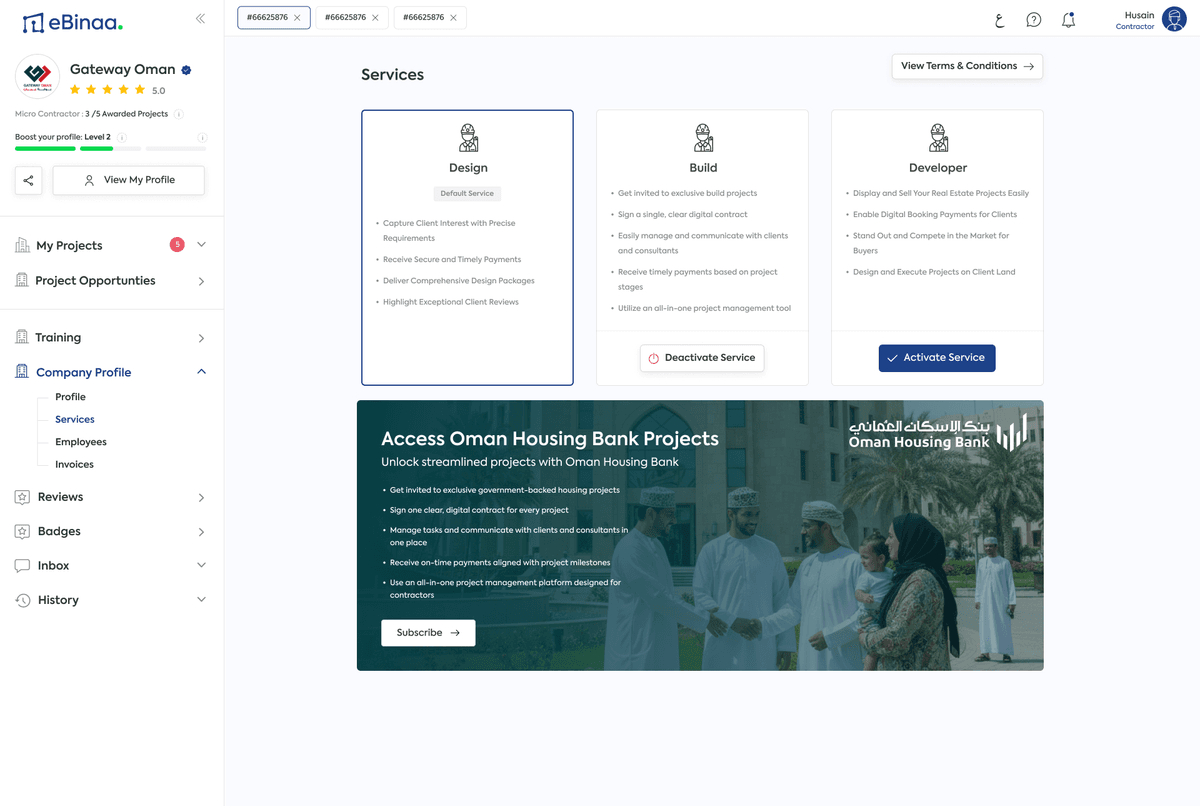
Before any colour touched the screen, I wireframed both surfaces in grayscale — the contractor's desktop workspace and the homeowner's mobile app — to settle hierarchy and the repeating card-and-status pattern that makes the whole platform feel predictable.
Grayscale wireframes built to the exact layout of the shipped screens — four contractor desktop surfaces and six homeowner / partner mobile screens — settled before any colour.
Calm, trustworthy, navy & green.
eBinaa runs on a calm, trustworthy system — deep navy as the primary, a bright green for actions and confirmation, on white — with semantic amber and red reserved for caution. Everything is defined as shared styles so a multi-service, bilingual product stays consistent, in both directions.
The other side — the company workspace.
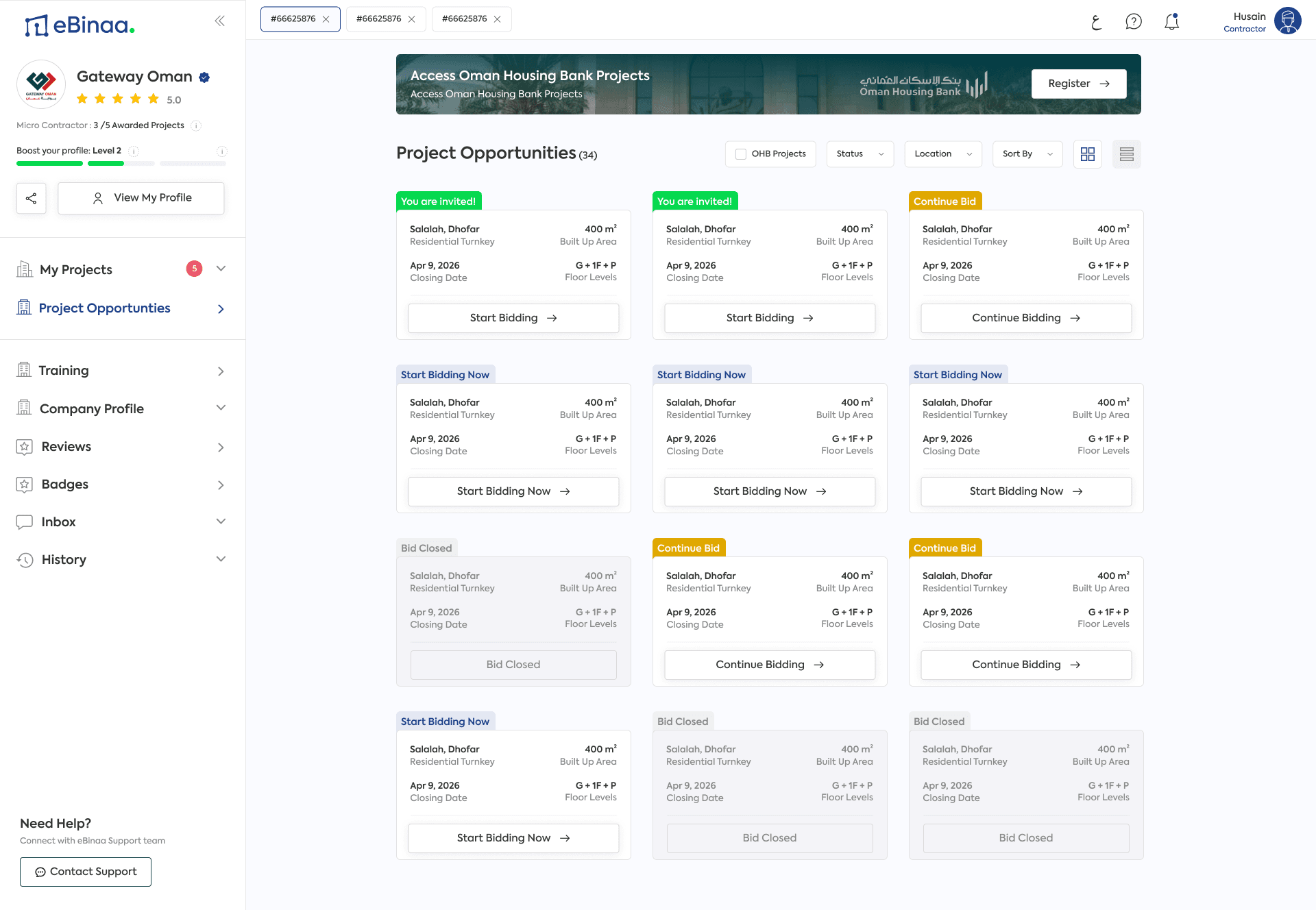
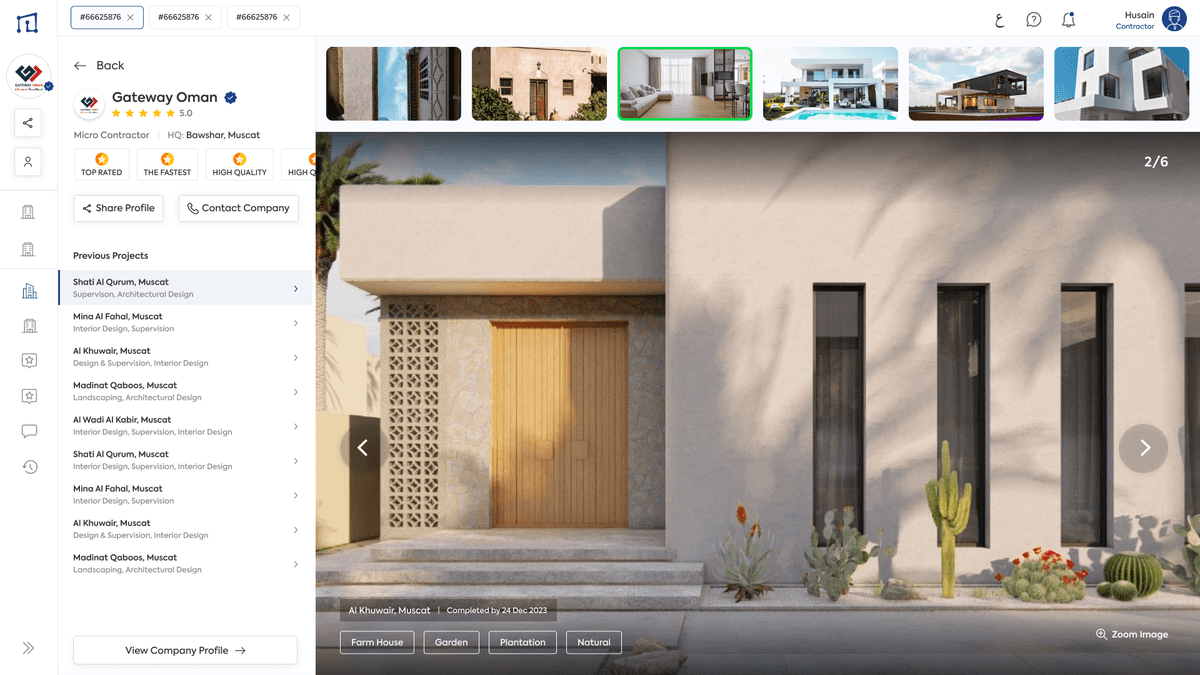
Trust runs both ways. While homeowners move through Design · Build · Buy on mobile, verified companies run their whole business from a desktop workspace — discovering opportunities, bidding, signing the contract, managing projects, proving credibility through a verification-driven profile, and collecting moderated reviews. The same status language carries across every surface, in English and Arabic.
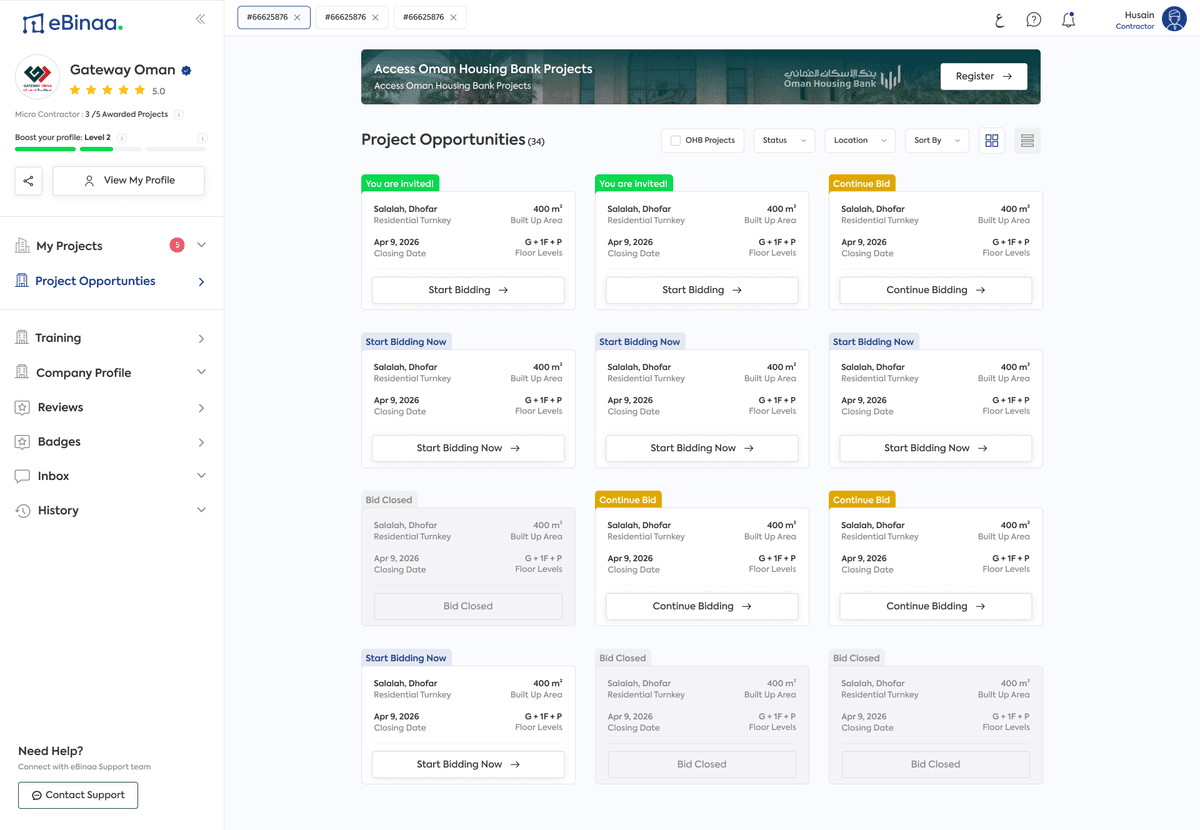
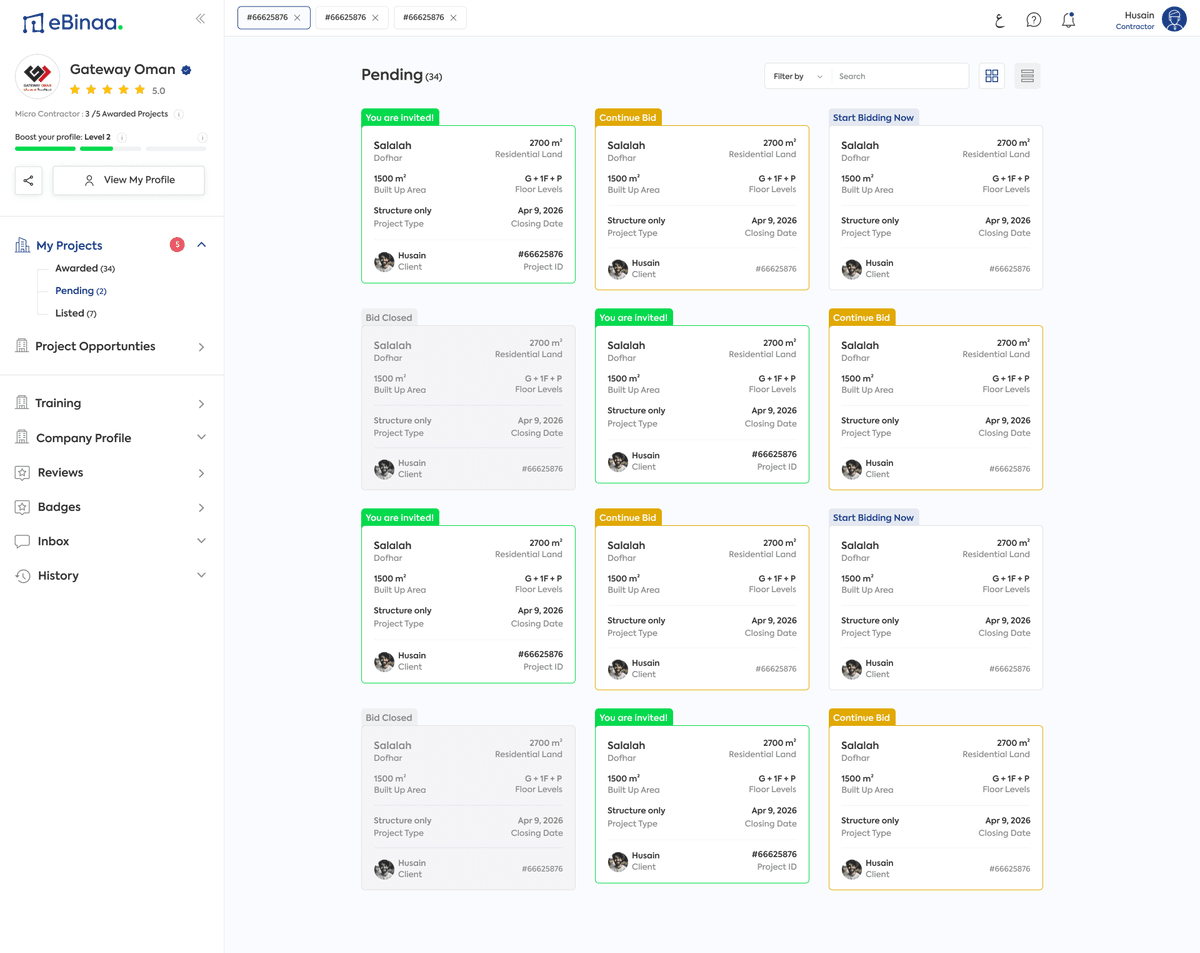
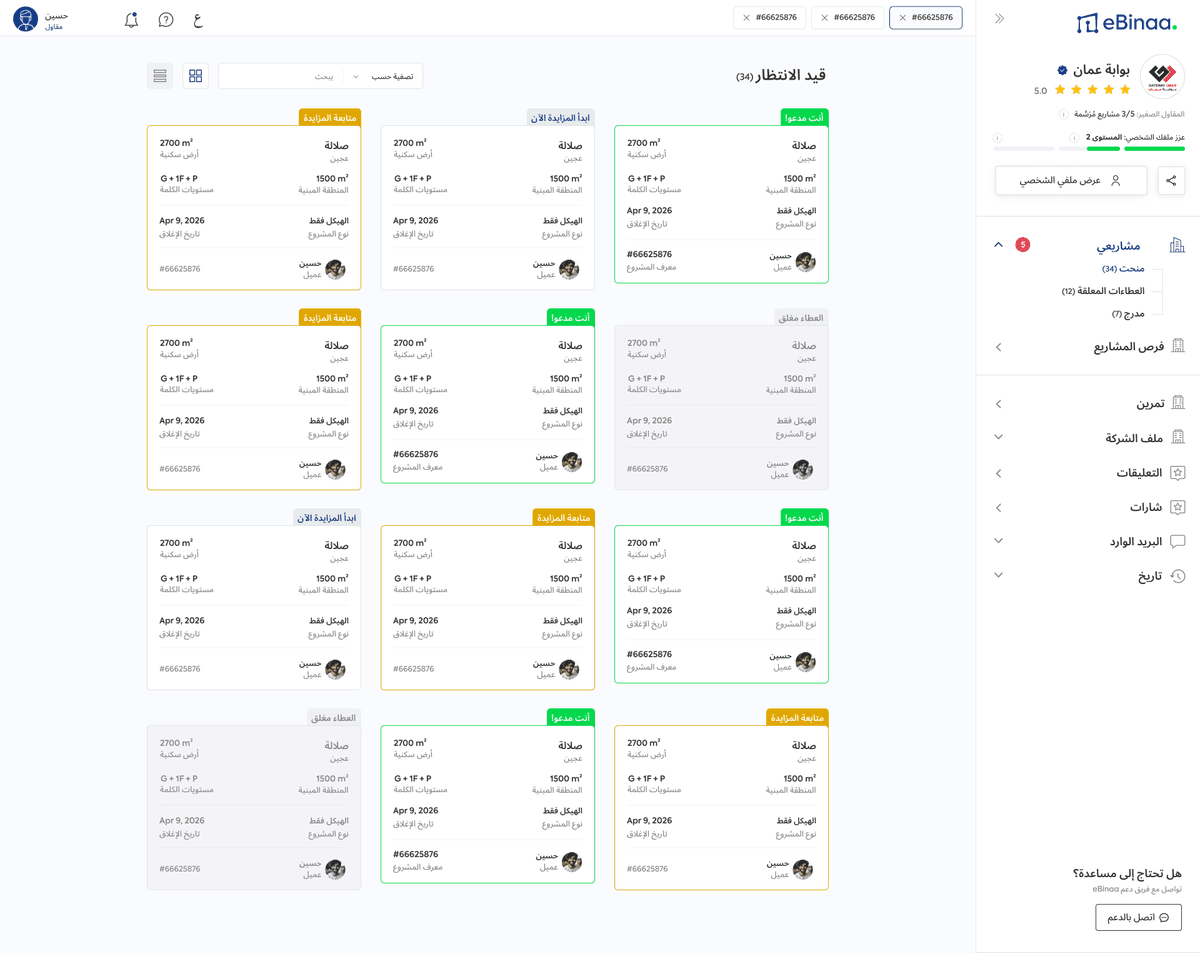
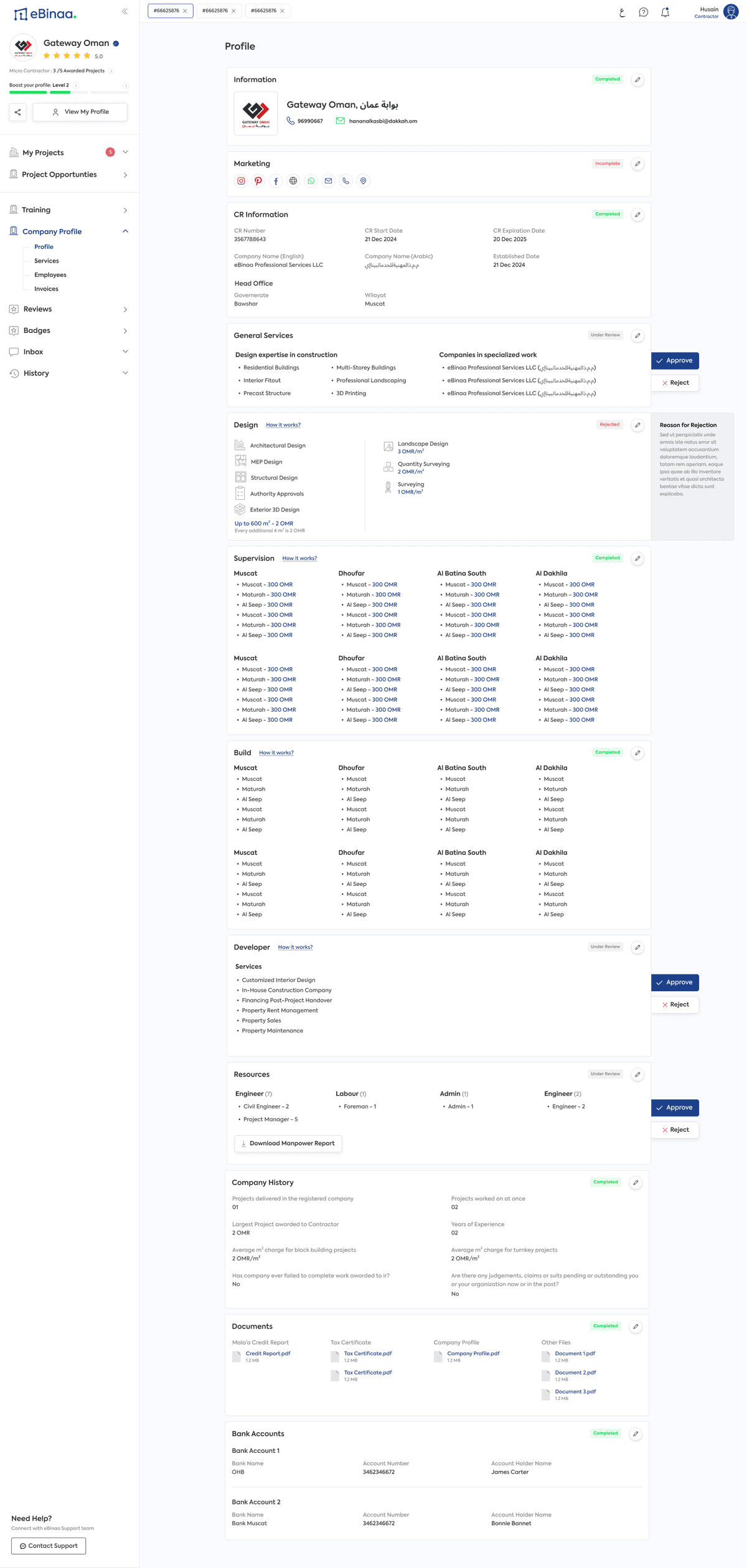
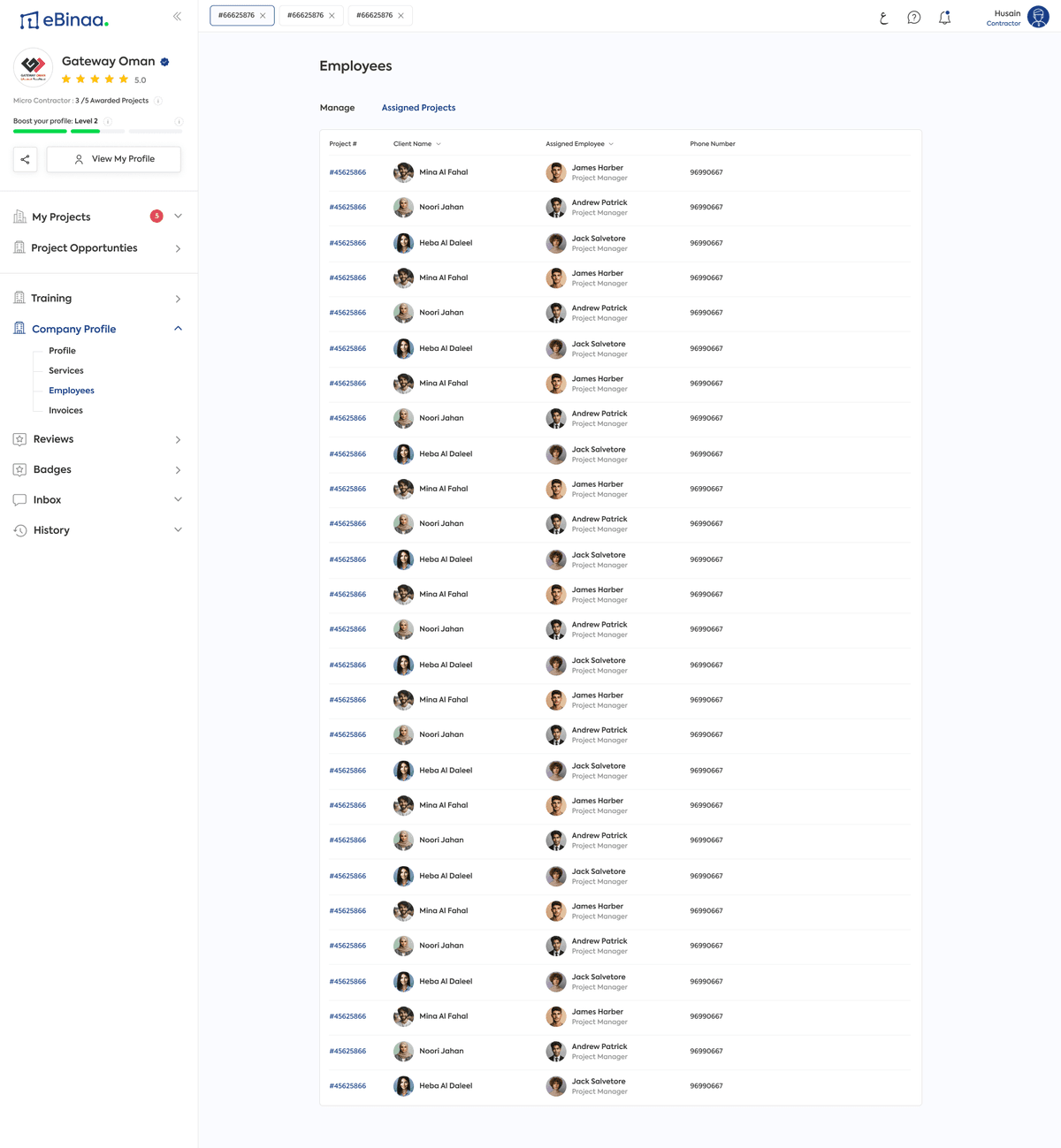
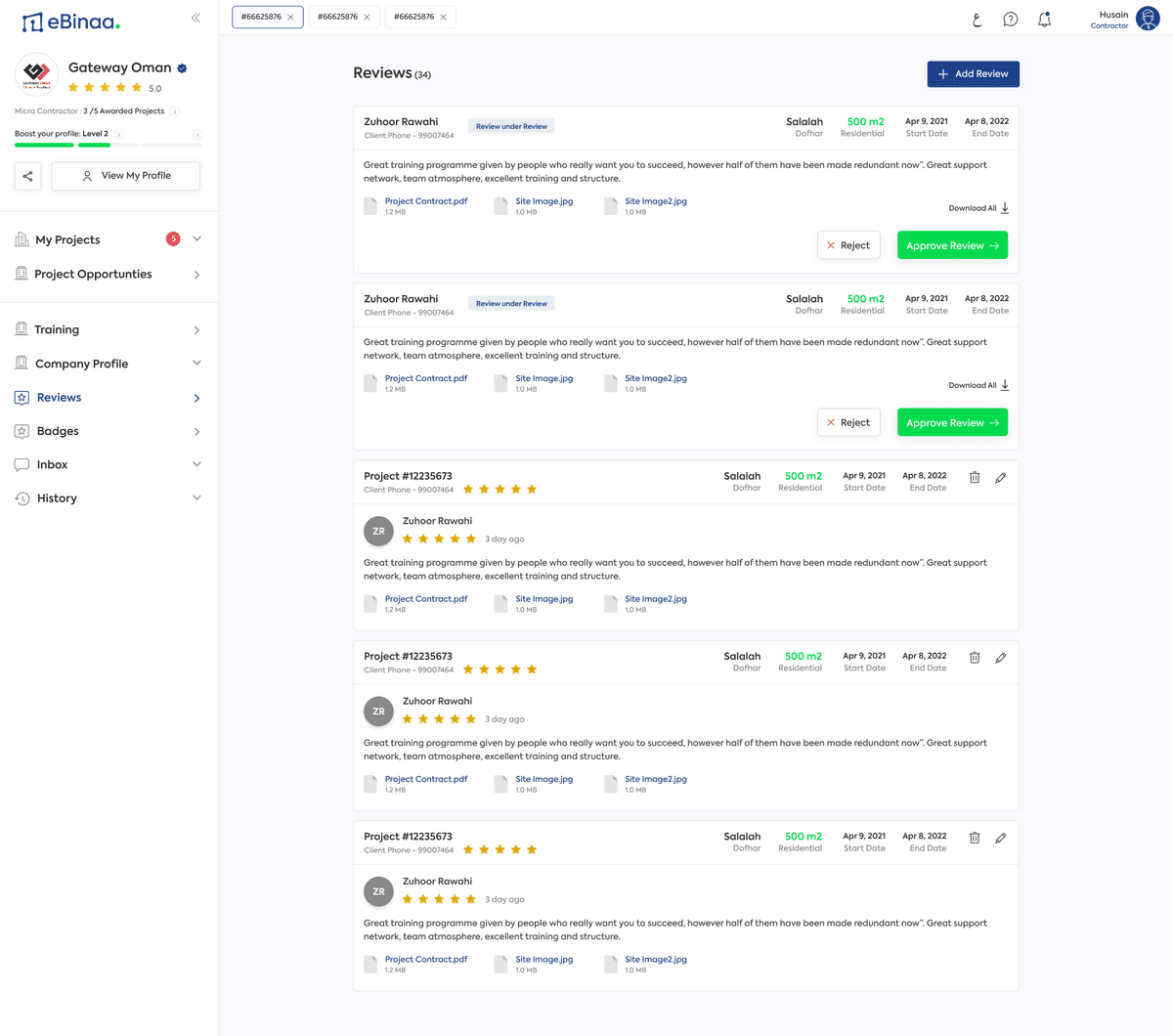
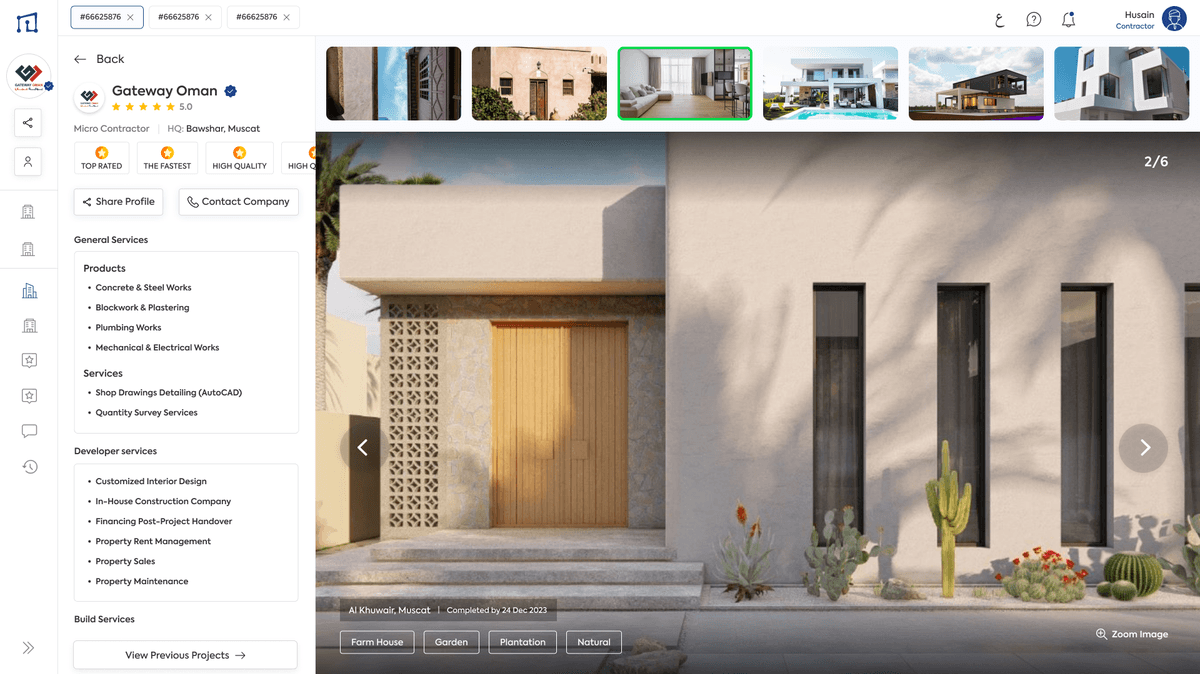
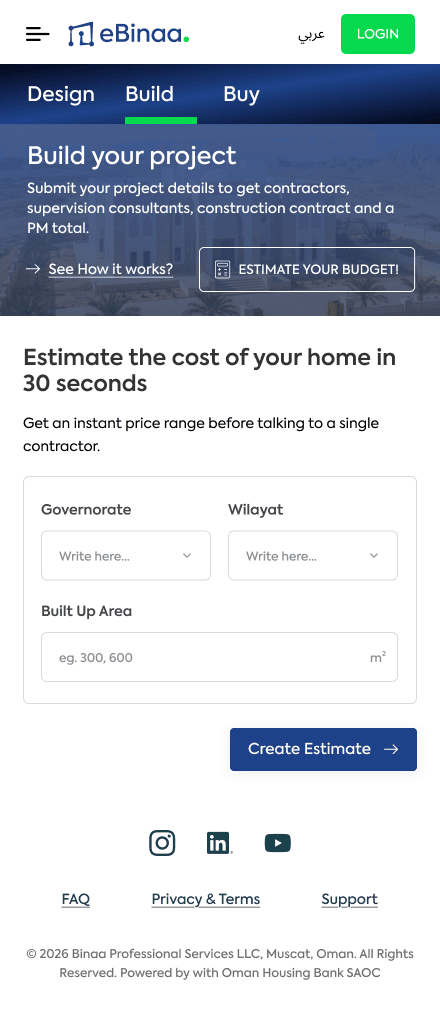
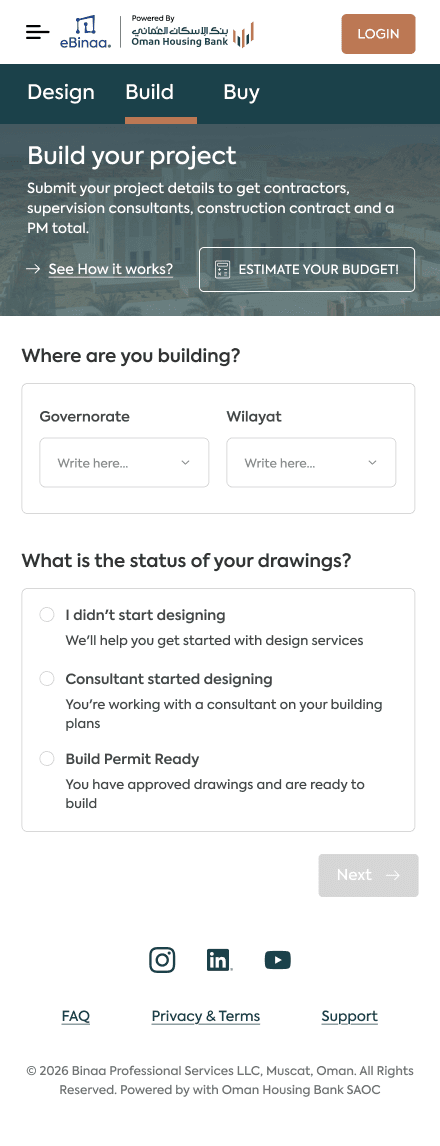
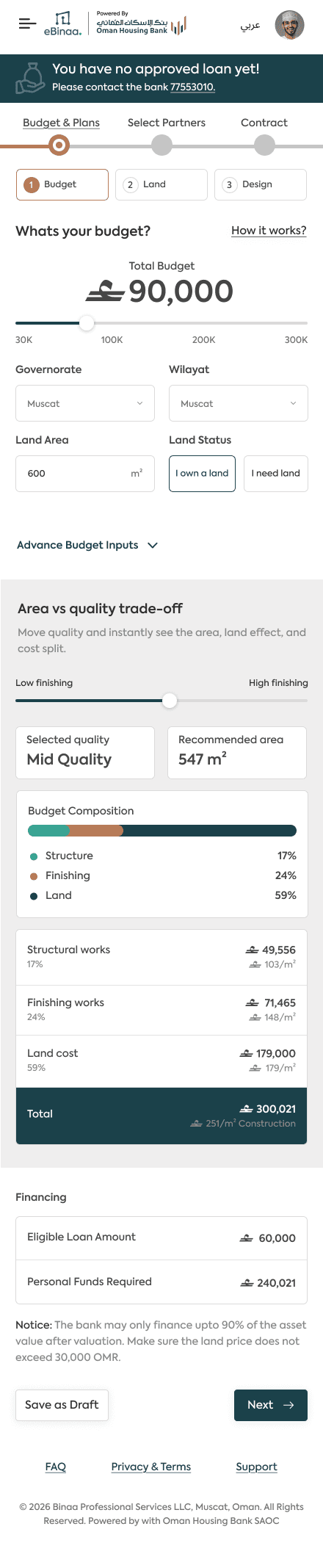
The shipped app, right to left.
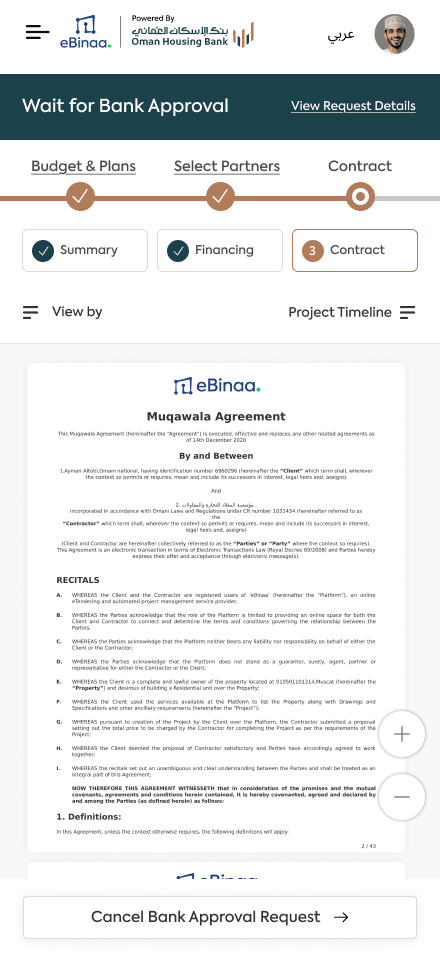
Every screen ships bilingual — a عربي toggle flips the whole product into a true right-to-left mirror. Here is the real, mobile-first product end to end: Design, Build, the budget planner, partner selection, the Muqawala contract and Buy. The full flow reads in order, top to bottom — Home first.











How I'd prove the bets actually work.
Live metrics sit outside the brief, so I won't claim numbers I never measured. Instead, every risky decision ships with a validation plan: a clear hypothesis, the method I'd run, and the one signal that would tell me I was right. Drop your real results into the band below.
Verified profiles make owners confident to reach out.
The right view to choose a firm.
An owner can submit a project without help.
Owners understand when and why money releases.
Trusted at scale, across all of Oman.
Trust isn't a feature you add at the end — it has to be built into how the money and the work move.
What the system taught me.
Trust is structural, not cosmetic.
Verification, fair contracts and staged money did more for confidence than any amount of reassuring copy.
Trust is a UX problem.
Making firms' track records and contract terms legible turned an act of faith into an informed decision.
Design lifecycles, not screens.
Modeling the build journey as an honest state machine — submit → contract → stage-pay → handover — prevented dead ends.